Donor agreements and key facts
When you are entering into a donor arrangement, one of the biggest things to understand is that how conception happens matters legally.
The legal position can be very different depending on whether conception happens through artificial insemination or through sexual intercourse.
We always recommend having a written donor agreement in place. It gives everyone a chance to talk through expectations, boundaries and intentions before conception happens. It doesn't guarantee every future situation will play out exactly as written, but it gives everyone a clear record of what was agreed from the beginning.
Laws around natural insemination (NI)
Natural insemination means conception through sexual intercourse.
In New Zealand, this can put both the donor and recipient in a very different legal position from conception through artificial insemination.
If you are considering NI, we strongly recommend getting legal advice beforehand. Even where both people are completely clear that the intention is sperm donation only, the law may not treat the arrangement in the same way as an artificial insemination donation.
This can affect things such as legal parentage, guardianship and child support.
Conception through sexual intercourse
The excerpt below is included to highlight how the law may treat conception through sexual intercourse differently from artificial insemination.
Quoting the New Zealand Law Commission paper (via nzlii): A man may participate in sexual intercourse for the sole purpose of enabling a woman to achieve a pregnancy, with the joint intention of them both that he is to have no rights or responsibilities in relation to the child. It is generally agreed that the special rules established by the Status of Children Amendment Act do not apply in this situation because conception resulting from sexual intercourse falls outside the legal definitions of "artificial insemination" and "assisted reproductive procedure". In law, the donor will be the father of the child, although he will not be a legal guardian unless the woman is his de facto partner or spouse. The donor will be liable for child support should the mother claim it.
Parental rights and responsibilities
New Zealand law has specific rules around assisted reproduction and legal parentage.
In many artificial insemination arrangements, a sperm donor who is not the recipient's partner will not be treated as the child's legal parent.
That does not mean you should skip the conversations around expectations.
A donor agreement is still incredibly useful because it puts things like contact, boundaries, updates, intentions around parentage and future involvement in writing.
If your arrangement involves co-parenting, significant ongoing donor involvement, or anything outside a straightforward donor arrangement, getting a family lawyer involved is a very good idea.
Birth registration is also something worth talking about before conception rather than leaving it until a baby arrives.
Payments and sperm donation
Sperm donation in New Zealand is intended to be altruistic. That means a donor should not be receiving a fee or financial reward simply for providing sperm.
Reasonable expenses connected with donating may be different. For example, you may agree to cover genuine travel costs incurred because of the donation.
If money is involved, keep it simple and transparent. Be clear about what is being reimbursed and keep a record of it.
Why are payments restricted?
These rules help reduce exploitation and discourage arrangements that prioritise profit over the well-being of donor-conceived children. They also help avoid situations where donors feel incentivised to donate broadly without considering long-term impacts.
Birth certificates and the law
Birth registration can bring up a lot of emotion, but it can also have legal consequences.
Before completing the registration, make sure you understand who will be recorded, what that means and whether it reflects the arrangement everyone intended.
You may also come across references to the Australian case Masson v Parsons when reading about sperm donation.
That case is Australian, so it is not New Zealand law. It is often mentioned because it shows how complicated things can become when a donor arrangement and the reality of someone's involvement in a child's life start to overlap.
If you are considering co-parenting, significant donor involvement or listing a donor on documentation, get New Zealand legal advice specific to your circumstances.
Birth registration and family structures
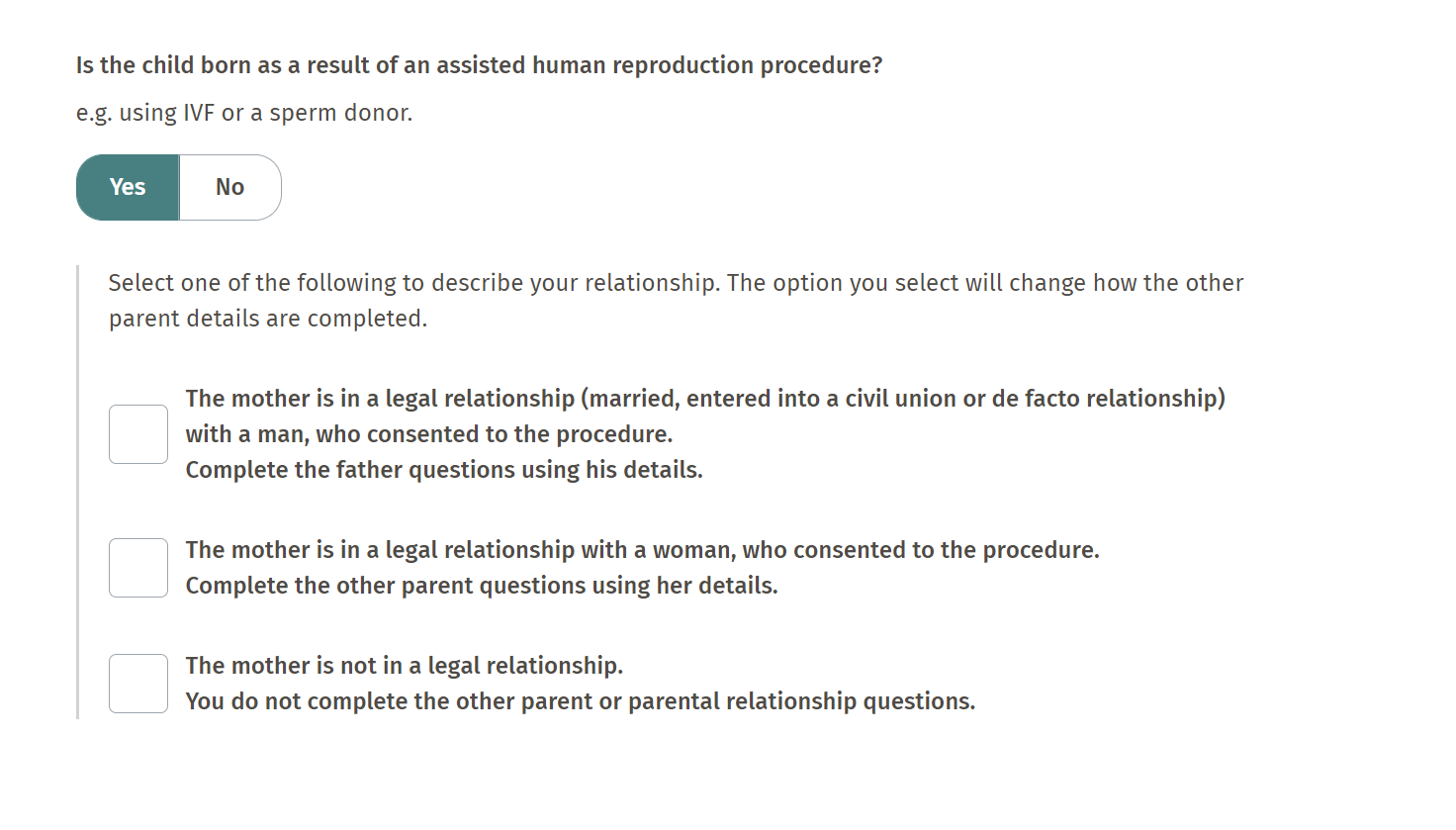
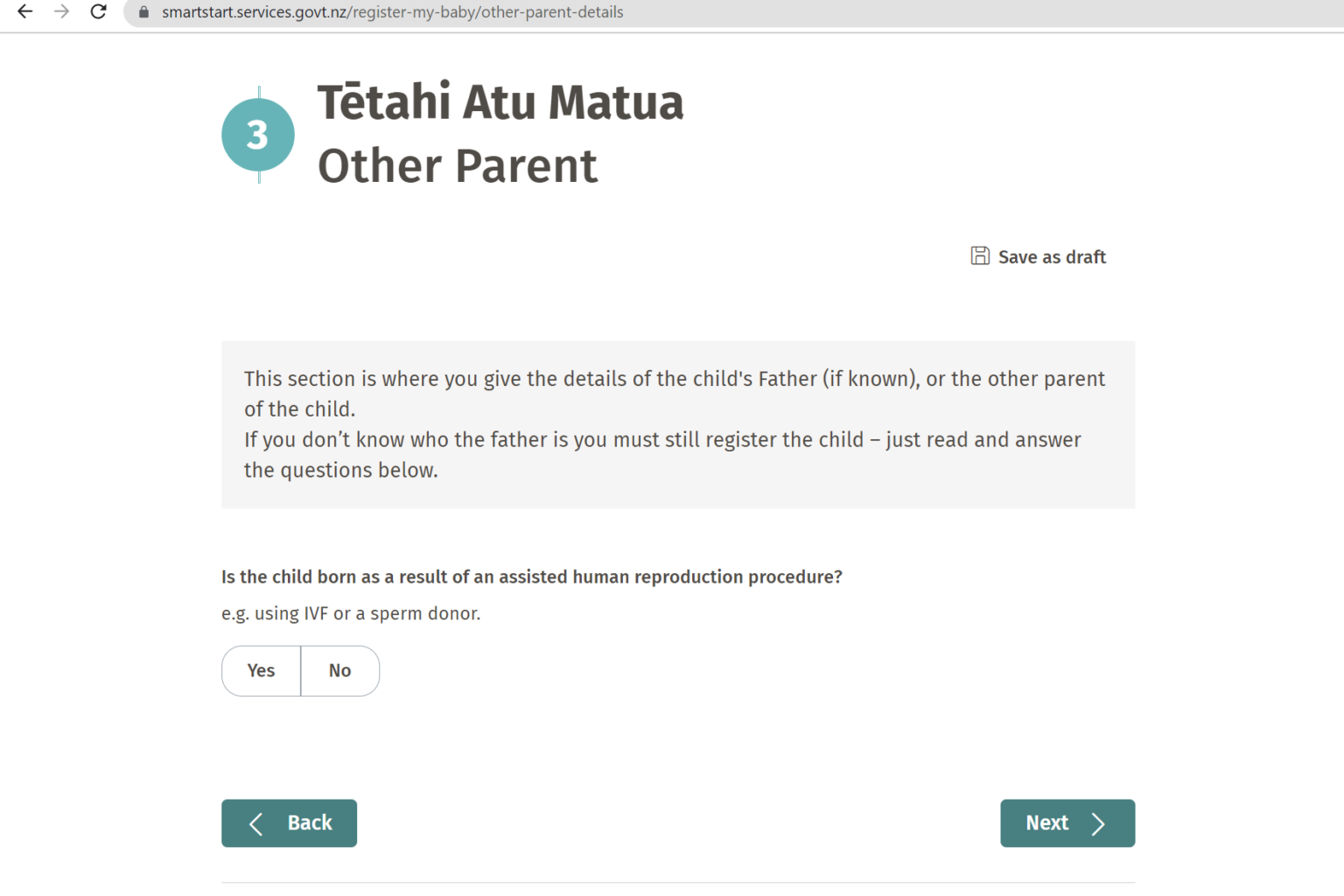
New Zealand's birth registration process has changed over time, including the options available to different family structures.
When you register a birth, use the current SmartStart process and read the wording carefully before completing it.
The screenshots below were taken in November 2021 and are here as an example of what the process looked like at the time. The current options may be different.
Screenshots taken in November 2021
Putting together a donor recipient agreement
Once you have found a donor, sitting down and creating an agreement can feel a little awkward. Do it anyway.
Some of the conversations can feel very hypothetical at the time, but they are much easier to have before there is a pregnancy or a child involved.
An agreement gives both sides the opportunity to say, This is what I expect. This is what I am comfortable with. This is where my boundaries are.
It also gives you a reason to talk about things that might otherwise get pushed aside because they feel uncomfortable.
We cover some of the other conversations worth having with a donor on our about your donor page.
Here is the agreement template: download agreement template
A few things we think are worth discussing
Talk about the awkward scenarios before they become real scenarios.
It might feel like overthinking things at the beginning, but these are exactly the conversations that can save a lot of confusion later.
- What happens if you see each other in public? Do you say hello? Does that change if the donor is with their partner, children, friends or family?
- Who knows about the donation? Does the donor's partner know? Their parents? Their children? What happens if someone who does not currently know finds out later?
- What updates will be shared? Does the donor want to know when there is a pregnancy? A birth? Do they want occasional photos or updates about the child? If so, how often?
- Can photos be shared with other people? If you send the donor a photo of your child, are they allowed to show their partner or family? Post it online? Save it privately?
- What happens when your child starts asking questions? Are you comfortable showing them a photo of the donor? Can they contact the donor? Is there an age when everyone would be open to meeting?
- What happens if someone's circumstances change? New relationships, more children, a move overseas or simply a change in how someone feels can all affect an arrangement years down the track.
You cannot predict every situation that might come up over the next 18 years. The point is not to try. The point is to make sure everyone starts from the same place, understands the arrangement, and has talked about the things that matter most.