So you've done the hard part, you've found a sperm donor in NZ. Maybe he's a friend, a private donor you connected with through a community group, or someone referred through a donor matching network. Either way, that step took courage, trust, and probably more spreadsheets and conversations than you expected.
Now comes the next question: What actually happens next?
This guide walks you through everything, the legal side of using a donor in New Zealand, what at-home insemination actually involves, how to choose the right insemination kit, and how to time everything correctly with ovulation tracking. Whether you're a lesbian couple, a same-sex female partnership, or a single woman by choice, this is the practical next-step guide nobody handed you.
First: Understand the Legal Framework for Donor Insemination in NZ
Before you do anything else, it's worth getting clear on where New Zealand law stands on sperm donation and donor insemination because it affects both your rights and your donor's.
New Zealand operates under the Human Assisted Reproductive Technology Act 2004 (HART Act), which governs all assisted reproduction in the country. The short version: New Zealand does not allow anonymous sperm donation. Any donor-conceived child has the right to access identifying information about their donor once they turn 18.
This means:
- Known donors (friends or private donors you've found yourself) are common in NZ precisely because the system is already built around non-anonymity.
- If you use a New Zealand sperm bank, the same rules apply - no anonymous donations.
- Paid sperm donation is not permitted in NZ. Donors can be reimbursed for reasonable expenses, but sperm donor NZ arrangements cannot involve payment for the donation itself. (If you've seen ads for "sperm donor NZ paid" arrangements, tread carefully and get legal advice.)
👉 For a full breakdown of the legal landscape, read our detailed post: NZ Donor agreements and legalities
One practical thing to sort before insemination: a known donor agreement. This isn't a legally binding contract in the way some assume, but it documents the intentions of everyone involved - parental rights, the donor's role in the child's life, financial responsibilities. You can find a draft form on this post - NZ donor agreements and legalities
What Is At-Home Insemination, Really?
At-home insemination, sometimes called DIY sperm donation or at-home donor insemination is exactly what it sounds like: the process of introducing donor sperm into the reproductive tract at home, without a clinic.
The method most commonly used at home is intracervical insemination (ICI), where sperm is deposited at the cervix using a soft syringe or catheter. This mimics the natural process of conception and is safe, non-invasive, and widely practised by lesbian couples and solo parents using a known donor.
ICI is different from IUI (intrauterine insemination), which places sperm directly into the uterus and is only performed by a medical professional. ICI can be done at home; IUI cannot.
Here's what a typical at-home insemination looks like:
- You've confirmed ovulation is approaching (more on this below)
- Your donor provides a fresh sample, ideally within 30–60 minutes of use
- You use a sterile insemination syringe to draw up and introduce the sample
- You remain lying down for 15–30 minutes afterward
That's the core of it. Simple in description but the details matter enormously, which is why the kit you use and the timing of ovulation both make a real difference to your chances.
Choosing the Right At-Home Insemination Kit
The at-home sperm donor kit market has grown significantly, and not all kits are created equal. Here's what to look for and what we stock.
What a good kit includes:
- A sterile, soft-tip syringe (5ml or 10ml) - the syringe needs to be medical-grade and free of any lubricants or additives that could harm sperm
- A sterile collection cup - for your donor to provide the sample hygienically
- A conception cup - to hold sperm close to the cervix after insemination
- Detailed instructions - ideally with timing guidance and a step-by-step process
What to avoid:
- Any kit that isn't labelled as sperm-safe as standard syringes can contain residues harmful to sperm motility
- Kits with low-quality or unclear instructions
- Anything that feels like a novelty rather than a medical-grade product
Our recommended kits:
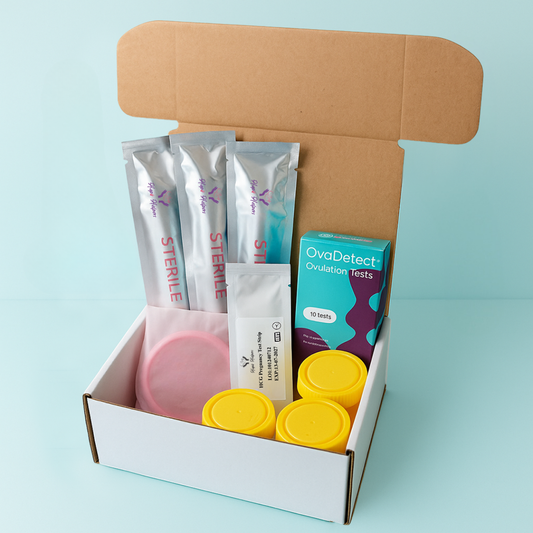
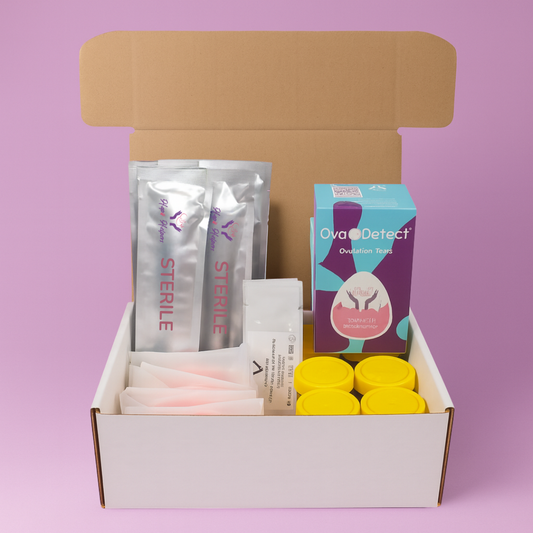
The Dinky Insemination Kit - Ideal for first-time use. Includes ovulation tests, sterile syringe, collection cups, disposable soft disc, hCG pregnancy test strips and step-by-step guide. Everything you need, nothing you don't.
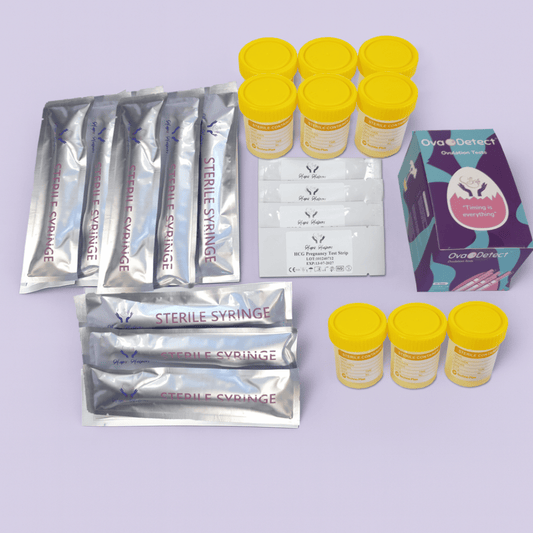
The Mezzo - 6 cycle at-home insemination kit - Our most popular kit for lesbian couples. Includes everything in the basic kit plus extras to try for multiple cycles.
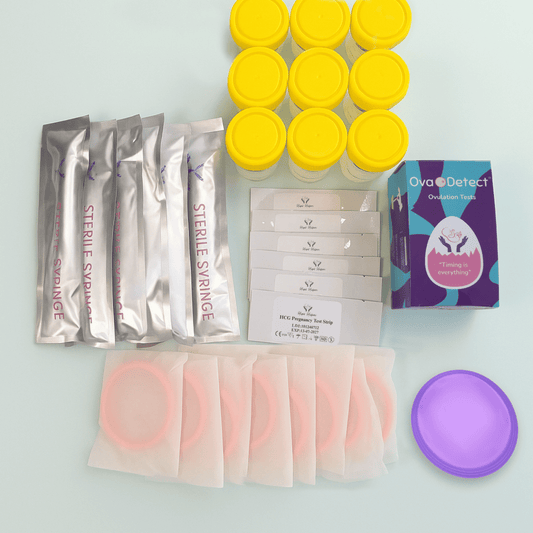
The Stellar - 9 cycle at-home insemination kit - If you're planning for multiple attempts across several cycles, this gives you everything you need stocked up and ready.
💡 Tip: Order your kit before your ovulation window opens, not during it. Rushing the purchase means rushing the process or missing your fertile window.
Ovulation Tracking: The Most Important Variable
Timing is everything in donor insemination at home. A healthy egg is only viable for 12–24 hours after ovulation. Sperm can survive inside the reproductive tract for up to 5 days, but for home insemination with fresh donor sperm, the optimal window is typically the 24–36 hours leading up to ovulation and the day of.
Getting this window right is the single biggest factor in your success rate.
The methods, ranked by reliability:
1. LH Surge Testing (Ovulation Predictor Kits / OPKs) This is the most accessible and reliable method for most people. OPKs detect the luteinising hormone (LH) surge that occurs 24–36 hours before ovulation. When you get a positive test (a line as dark or darker than the control line), that's your insemination window.
Ovadetect Ovulation Test Strips - Test daily from around Day 10 of your cycle. Test at the same time each day (afternoon is optimal, not first morning urine).
2. Basal Body Temperature (BBT) Tracking Your resting body temperature rises slightly after ovulation - about 0.2–0.5°C. Tracking this daily with a basal thermometer can confirm that ovulation has occurred, but it's retrospective, it tells you ovulation has happened, not that it's about to. Best used in combination with OPKs to understand your cycle pattern over time.
Ovulation Thermometer - Basal Body Temperature
3. Cervical Mucus Monitoring In the days before ovulation, cervical mucus becomes clearer, more slippery, and stretchy, often described as resembling raw egg whites. This is a sign of peak fertility. Combined with OPKs, it gives a strong picture of your fertile window without any equipment.
4. Cycle Tracking Apps Apps like Clue, Ovia, or Natural Cycles can help you understand your cycle length and predict your fertile window, but these are estimates based on averages. They're most useful as supporting data, not as your primary ovulation signal.
A practical timing plan:
| Day | Action |
|---|---|
| Cycle Day 10–11 | Start testing with OPKs daily |
| LH surge detected (positive OPK) | Plan insemination for that evening or the following morning |
| Day of insemination | Confirm with donor; allow for fresh sample within 1 hour |
| 12–24 hours later | Second insemination attempt if possible (many couples do two) |
| 2 weeks after ovulation | Earliest reliable pregnancy test date |
On the Day: A Practical Checklist
When the time comes, having everything ready reduces stress and helps you focus on the experience rather than the logistics.
Before:
OPK positive confirmed
Donor informed and confirmed
Kit unpackaged, components checked
Collection cup labelled and ready
Comfortable space prepared (towel, pillow for hips)
During:
Sample collected and handed over within 30–60 minutes of collection
Draw sample into syringe slowly (avoid air bubbles)
Insert syringe gently - no force needed
Depress plunger slowly and steadily
Remove syringe, remain lying down for 15–30 minutes
Insert a conception disc to hold the sample in place (Some people can't use an internal disc because of vaginismus, pelvic pain, sensory sensitivities, or because they simply prefer a more straightforward approach to at-home insemination)
After:
Note the date, time, and cycle day in your tracking app or journal
Mark your calendar for a test date (14 days post-ovulation)
Be kind to yourself, one attempt is rarely the whole story
What About Using a New Zealand Sperm Bank?
If you haven't found a private donor yet or if you've decided a known donor arrangement isn't right for you, a New Zealand sperm bank is the other route.
New Zealand has limited domestic sperm bank options due to the non-anonymous donation rules (which restrict the donor pool). Many NZ fertility clinics work with international sperm banks that ship frozen donor sperm to NZ, where it's then used for IUI or ICI.
The cost of sperm donation via a NZ bank route is considerably higher than using a known donor:
- Imported donor sperm vials: $1,500–$3,000+ NZD per vial
- Clinic fees for IUI: $1,000–$2,500+ per cycle
- Total per cycle: can exceed $4,000–$5,000 NZD
By contrast, at-home insemination with a known donor's primary costs are the insemination kit and ovulation testing supplies - a fraction of the price.
Sperm donor cost NZ is one of the most common search queries in this space, and for good reason: the financial barrier to clinic-based paths is real. The at-home route, when safe and legal, is a meaningful option for many families.