The good news: two of those three (ICI and IUI) are far more accessible than most people expect. One of them you can do entirely at home. This guide explains both clearly - what they are, how they work, what equipment you actually need, and how to decide which path makes sense for your situation.
IVF is a different category altogether, so we'll touch on it briefly at the end, but it's not the focus here.
What Is ICI (Intracervical Insemination)?
ICI stands for intracervical insemination. It's the most natural form of assisted conception where sperm is placed at the entrance of the cervix using a soft syringe, mimicking the end-point of intercourse.
It's the method used in at-home insemination, and it's what most people mean when they talk about DIY insemination, self insemination, or using a home insemination kit.
How ICI works:
- Sperm (from a known donor, partner, or a vial) is collected in a sterile cup
- The sample is drawn into a needleless, soft-tip insemination syringe
- The syringe tip is gently inserted to the cervix and the plunger is slowly depressed
- You remain lying down for 15–30 minutes after
That's it. No speculum. No stirrups. No clinic appointment.
Who typically uses ICI at home:
- Lesbian couples and same-sex female partners using a known donor
- Single women by choice using a known or private donor
- Heterosexual couples where conception through intercourse isn't possible
- Anyone who prefers to conceive in a private, comfortable, home environment
ICI is the foundation of DIY insemination which is why a quality at-home insemination kit matters. If you're researching home insemination kits in NZ, ICI is almost certainly the method you're preparing for.
What Is IUI (Intrauterine Insemination)?
IUI stands for intrauterine insemination. This is where sperm is placed inside the uterus, past the cervix using a thin, flexible catheter.
The important difference: IUI must be performed by a medical professional. It cannot safely be done at home.
Why? A few reasons:
- The sperm used for IUI must first be "washed" in a lab, a process that removes seminal fluid and concentrates the motile sperm. Unwashed sperm introduced directly into the uterus can cause painful uterine cramping and is not safe.
- The catheter used passes through the cervical os, which requires clinical training and sterile conditions.
- The procedure is often timed alongside ultrasound monitoring to confirm follicle development and ovulation.
How IUI works in a clinic:
- You attend a clinic on or around ovulation day (confirmed via ultrasound or LH monitoring)
- A sperm sample is prepared and washed in the lab
- A speculum is placed, and a thin catheter carries the washed sperm directly into the uterus
- The procedure takes about 5–10 minutes; mild cramping is normal
Who is IUI recommended for:
- People with mild male-factor infertility (low motility or count)
- Those using frozen donor sperm from a sperm bank (most banks supply IUI-ready washed vials)
- Anyone who has tried ICI at home for several cycles without success
- Those whose fertility specialist recommends moving to a clinical setting
IUI vs ICI: Side-by-Side Comparison
| ICI | IUI | |
|---|---|---|
| Where sperm is placed | At the cervix | Inside the uterus |
| Can it be done at home? | ✅ Yes | ❌ No, clinic only |
| Sperm prep required? | No, fresh, unwashed sperm is fine | Yes, sperm must be washed first |
| Equipment needed | Home insemination kit + insemination syringe | Clinical catheter + lab + speculum |
| Cost | Low, requires a kit only | Higher, clinic fees + lab fees |
| Success rate per cycle | ~10–15% (under 35, no fertility issues) | ~15–20% (under 35, no fertility issues) |
| Best for | At-home conception, known donors | Clinic-based care, frozen sperm, male-factor infertility |
| Invasiveness | Very low | Low–moderate |
The success rate difference between ICI and IUI is real but modest. For many people, the accessibility, privacy, and cost of ICI at home makes it the right starting point, especially in the first 3–6 cycles. From our experience, most people with no known fertility issues conceive on or before the 5th cycle.
What Does an At-Home Insemination Kit Actually Include?
A good home insemination kit is specifically designed for ICI. This is distinct from a standard medical syringe. The materials, tip design, and sterility requirements are all different.
What to look for in a quality kit:
- A soft-tip, needleless insemination syringe: medical grade, sperm-safe (no lubricant residues that harm motility)
- A sterile collection cup for the sperm sample
- Clear, step-by-step instructions specific to human insemination
What to avoid:
- Generic syringes not designed for insemination as they may contain additives harmful to sperm
- Anything marketed as novelty or "fun" rather than clinical
- Kits with vague or non-human-specific instructions
Our kit:
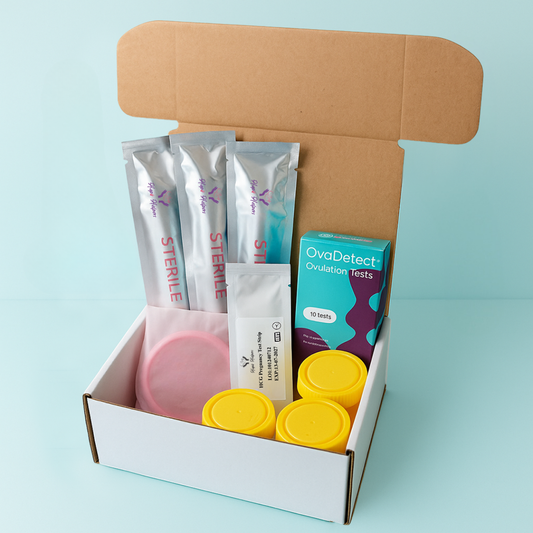
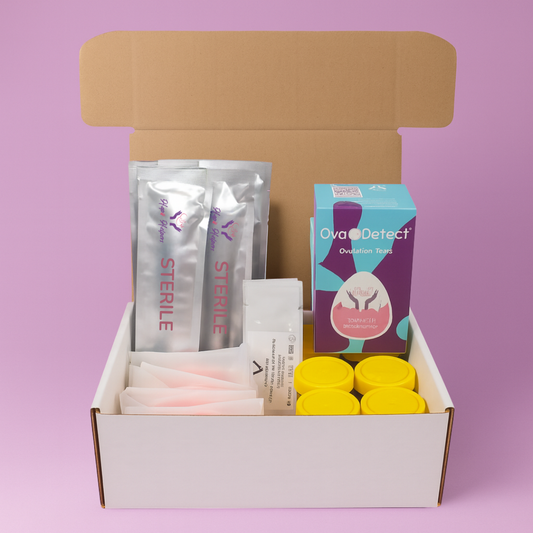
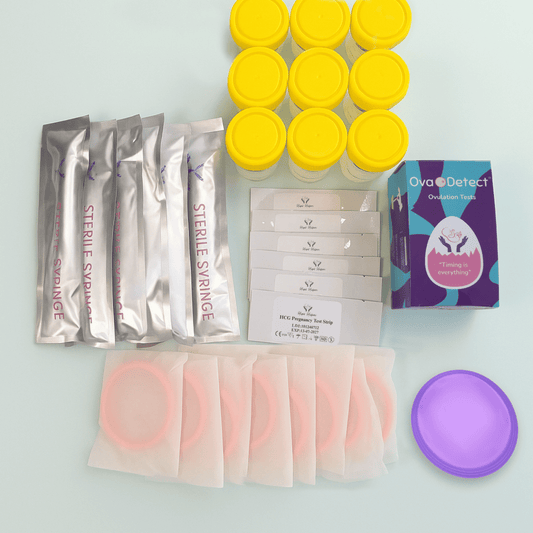
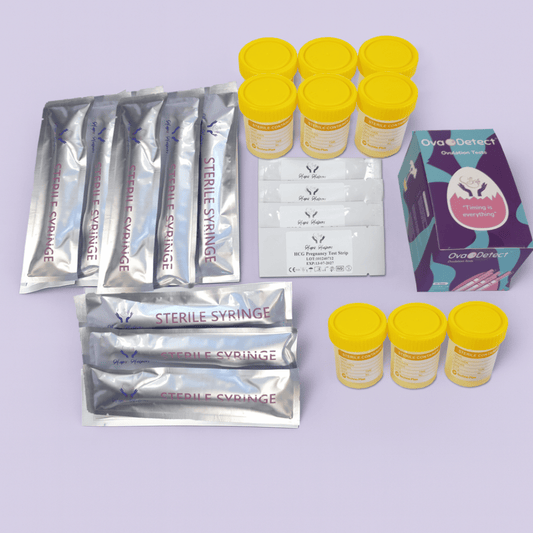
The Mezzo Insemination Kit - Sterile syringe, collection cup, ovulation test, pregnancy tests, conception disc and full instructions to guide you at home.
💡 One thing that catches people off guard: "IUI kit" and "ICI kit" are sometimes used interchangeably in product marketing even when the product is designed for ICI (at home use). If a kit can be purchased online and used without a medical professional, it's an ICI kit, regardless of what it says on the label.
At-Home Insemination Tips: Making the Most of ICI
Timing and technique are the two variables most within your control. Here's what makes a real difference:
1. Nail your ovulation window
This is the single biggest factor in success. An egg is only viable for 12–24 hours post-ovulation. The fertile window is the 1–2 days leading up to ovulation and ovulation day itself.
Use ovulation predictor kits (OPKs) to detect your LH surge (the hormone spike that precedes ovulation by 24–36 hours). When your test line is as dark or darker than the control line, you're in your window.
Ovadetect Ovulation Test Strips helps you pinpoint your fertile days with ease.
2. Use fresh sperm within an hour
For at-home ICI with a known donor, the sample should be used within 30–60 minutes of collection. Sperm motility drops significantly after that window. Have your kit ready and open before the sample is collected, not after.
3. Stay horizontal after insemination
Lie on your back with a pillow under your hips for 15–30 minutes after insemination. Gravity isn't the whole story and sperm can swim upstream but there's no reason to work against yourself, plus this is the method Taryn and Kat used when they were TTC.
4. Try two attempts per cycle
Many people do one insemination on the day of their positive OPK and a second 12–24 hours later. Two well-timed attempts in a cycle are generally better than one.
5. Track every cycle
Note the cycle day, time, OPK result, and any observations after each attempt. Patterns across cycles are useful, both for your own awareness and if you later consult a fertility specialist.
What About IVF?
IVF (in vitro fertilisation) is a fundamentally different process. Rather than introducing sperm into the body and allowing fertilisation to happen naturally, IVF involves:
- Stimulating the ovaries with hormones to produce multiple eggs
- Surgically retrieving those eggs
- Fertilising them in a laboratory
- Transferring one or more resulting embryos into the uterus
IVF is significantly more involved, more expensive and is generally recommended when:
- There are significant fertility barriers on either partner's side
- Multiple IUI cycles have not resulted in pregnancy
- There are known conditions like blocked tubes, severe endometriosis, or very low sperm count
You may have seen searches for "at home IVF kit", to be clear, IVF cannot be done at home. There is no such thing as a true at-home IVF kit. Products marketed this way are either ICI kits using loose terminology, or inaccurate.
If IVF is something you're considering, the right first step is a conversation with a fertility specialist or reproductive endocrinologist.
Which Should You Start With?
Here's a simple decision framework:
Start with ICI at home if:
- You have a known or private donor with fresh sperm
- You have no known fertility issues
- You want to try a lower-cost, private option first
- You're under 35 and have frequent cycles.
Move to IUI (clinical) if:
- You're using frozen donor sperm from a sperm bank (most require IUI)
- You've done 4-6 ICI cycles without success
- There's a known sperm motility or count issue
- Your GP or fertility nurse has recommended clinical support
Consider IVF if:
- IUI has not been successful after several cycles
- There are significant fertility factors on either side
- Your fertility specialist has assessed and recommended it
The most important thing: don't let perfect be the enemy of started. We know of many couples who conceived through ICI at home but spent weeks asking about and researching IVF before realising ICI was the right first step for them.