02 · Method

Bringing the journey home.

Home insemination, sometimes called at-home artificial insemination lets you take a clinical process out of the clinic and put it back in your own bedroom. For many people, that change matters.

The basics

What home insemination actually is.

Home insemination involves placing sperm from a known donor, a clinic donor programme, or from your own partner into the vagina (near the cervix) using an artificial insemination syringe. It's the same biology as natural conception. The only difference is that the sperm doesn't arrive the usual way.

It works best when you've nailed the timing (ovulation tracking matters more here than almost anywhere else) and you're using fresh, healthy sperm.

One thing to know: the legal landscape in Australia is friendly to home insemination, but how you set up your donor agreement matters a lot, especially if you're using a known donor. We cover that in Using a known donor.
Who uses this method

Three audiences, one
method.

Home insemination gets talked about as if it's only for one kind of family. It isn't. The kits and the process are the same, the source of the sperm is the only thing that varies.

With a donor · Known

Same-sex couples, solo parents, families using a known donor

The most-talked-about audience for home insemination, and historically our biggest. A trusted friend, family connection, or community-introduced donor provides fresh sperm at home, timed to ovulation.

With partner sperm

Heterosexual couples using the male partner's sperm

The audience most people don't realise this method serves and a very common reason families come to us. Sometimes called AIH (Artificial Insemination by Husband) or CAI (Conjugal Artificial Insemination). No donor, no legal paperwork, just a way to get sperm into the right place at the right time.

With a clinic donor

Recipients of sperm released from an AU clinic

Less common than the above two, but possible. Some AU clinics will release donor sperm for at-home insemination in specific circumstances (talk to your clinic). Process is the same; logistics around thawing are different.

If you're a heterosexual couple, this might be new to you: AIH at home is genuinely common and meaningfully effective. It's used for mild male-factor issues (low motility, low count, low volume), for couples dealing with sexual dysfunction or anatomical pain that makes intercourse difficult, for situations where vasectomy reversal or retrograde ejaculation is in play, and sometimes simply for couples where work travel keeps making the timing impossible. The same Hapū insemination kits work identically and there are no legal hoops to jump through when the sperm is your partner's. We touch on this more in Building your family with a partner.
The three methods

ICI vs IUI vs IVI - explained without the jargon.

ICI · Most common at home

Intracervical Insemination

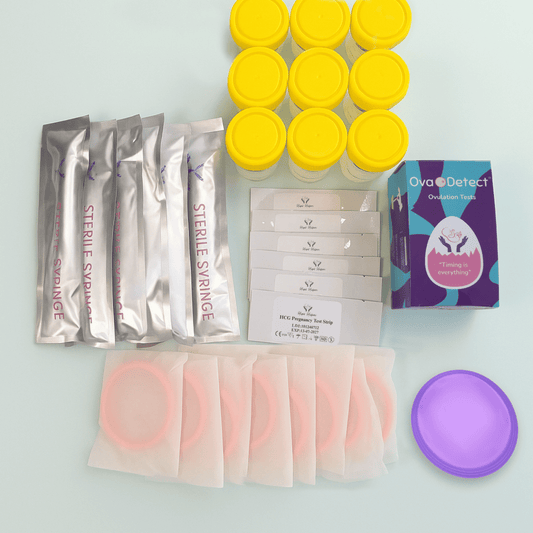
Sperm is placed near the cervix using a syringe. It's the simplest and most commonly used home insemination method, and what most home kits are designed for. No medical training required.

IVI · Intravaginal

Intravaginal Insemination

Sperm is placed inside the vagina using a syringe. Similar to ICI, but not aimed directly at the cervix. Often paired with a soft disc to help keep sperm closer to the cervix.

IUI · Clinical only

Intrauterine Insemination

Sperm is placed directly into the uterus using a thin catheter. This procedure must be performed by a clinician and isn't suitable for home insemination, but it's helpful to understand as another fertility treatment option.

The process

What it actually looks like,
step by step.

01

Track your cycle

Use OPKs to identify your LH surge. You'll inseminate within 12-36 hours of that.

02

Source the sperm

Fresh sperm (partner or known donor) is best used within 30–60 minutes of collection. Logistics matter, make sure to plan the day.

03

Inseminate

Use the syringe to place sperm near the cervix. Lie flat for 20-30 minutes after.

04

Wait

The two-week wait. Be gentle with yourself.